If you’ve ever rummaged through a tool bag, you might have noticed sets of hand-tools that look almost identical — some people call them spanners, others call them wrenches. And that’s where the confusion begins. While both types of tools serve the same core function — loosening and tightening nuts and bolts — they aren’t always used interchangeably, depending on region and design.
In this article, we’ll break down what distinguishes spanners vs wrenches, explore their common types, and help you decide which tool is right for which job.
What’s Behind the Names: Spanners vs Wrenches
The biggest part of the confusion comes simply from language and regional usage. In many parts of the world — including the UK, India, Australia, and other Commonwealth countries — the term “spanner” is more common.
Meanwhile, in the United States and other regions that follow American English, “wrench” is the default term for most of these tools.
However — and this is key — what’s considered a “spanner” or a “wrench” depends not just on where you are, but often on the tool’s design. In many contexts:
- Spanner refers to a fixed-size tool designed for a specific nut or bolt.
- Wrench tends to refer to adjustable tools — ones where the jaw can be changed to fit different sizes of nuts or bolts.
Put another way: almost everywhere the function is the same — but the naming depends on both geography and tool variation.
What Is a Spanner?
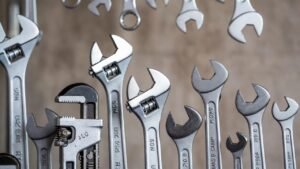
A spanner is a tool with a fixed jaw — that is, it’s made to fit a single size of nut or bolt. Because of that snug, precise fit, spanners are often preferred when accuracy matters.
Some common types of spanners include:
- Open-ended spanner: With a U-shaped jaw — great for quick access and frequently used bolts.
- Box (ring) spanner / tubular spanner: These have a closed loop (or tube) and are useful for nuts/bolts in tight, hard-to-reach spaces — like engine bays or electrical panels.
- Combination spanner: One end open, one end ring — gives flexibility without switching tools.
Because spanners are often slimmer and lower-profile, they shine in constrained spaces where every millimeter counts. They are widely used in automotive repair, industrial maintenance, aerospace, and other engineering contexts where precision matters.
Pros of spanners:
- Precise fit reduces slippage or rounding of nuts/bolts.
- Easier to maneuver in tight or confined spaces.
- Lightweight and often more compact.
Cons of spanners:
- Need one spanner per bolt/nut size — so you might end up needing a full set to cover different fasteners.
- Less flexible if you don’t know the exact size or have multiple sizes to handle.
- What Is a Wrench?
A wrench is generally a tool with an adjustable jaw — meant to grip nuts and bolts of different sizes. Because of this adjustability, wrenches are often the go-to choice when you don’t know the size of the fastener or when you’re working with assorted bolts and nuts.
Common types of wrenches include:
- Adjustable wrench (also called adjustable spanner in some countries): One tool for many sizes — useful when working across different fasteners.
- Pipe wrench (or pipe spanner): Designed for round surfaces like pipes — the teeth bite into the surface to grip firmly, making them ideal for plumbing work.
- Torque wrench: Used when you need to apply a precise amount of torque — crucial in automotive or mechanical applications to avoid over-tightening or under-tightening.
- Pin-hook/Pin- or hook-type wrenches: For specialized fittings such as rings, collars, or locknuts.
Because of their versatility, wrenches are often the preferred tool in general household DIY, furniture assembly, plumbing, or varied repair jobs.
Pros of wrenches:
- Adjustable — one tool can manage multiple fastener sizes.
- Convenient for mixed jobs, unknown fastener sizes, or on-the-go tool use.
- Useful for non-standard shapes — like pipes or rounded fittings.
Cons of wrenches:
- Bulkier and heavier compared to spanners — can be awkward in tight spaces.
- Adjustable jaws may not grip as precisely — more prone to slipping or rounding bolts if not tightened properly.
- Less ideal for precision work where exact bolt size matters.
Which Tool Should You Pick — When?
The choice between a spanner and a wrench largely depends on what you’re trying to do. Here are some scenarios to help you decide:
- Tight space / precision work (e.g. engine bays, confined mechanical parts, radiator or plumbing fixtures) ⇒ Use a spanner. The snug fit and slim profile make it safer and more precise.
- General-purpose repairs, furniture assembly, mixed fastener sizes, unknown bolt sizes ⇒ Go for a wrench. Its adjustability offers flexibility and saves you from carrying a large set of fixed tools.
- Plumbing, pipe work, round fittings ⇒ A pipe wrench (a type of wrench) is better suited, because its design grips rounded surfaces more securely than a standard spanner.
- When torque matters (e.g. engine bolts, wheel nuts, mechanical components where over/under-tightening can cause damage) ⇒ Use a torque wrench for controlled tightening.
- In many toolboxes — especially for professionals — both a set of spanners and a couple of wrenches are considered essential. There’s no “one-size-fits-all” answer: it’s about matching the tool to the task.
Spanner vs Wrench — The Bottom Line
At their core, a spanner and a wrench are tools designed to do the same job: apply torque to nuts, bolts, and fasteners.
But the subtle differences — in design, adjustability, practicality, and even terminology — make the difference between a smooth, safe job and a frustrating (or even risky) one. In many cases, a fixed spanner gives you precision and security; a wrench gives you flexibility and convenience.
Whether you’re a DIY enthusiast living in New Delhi or a professional mechanic refurbishing heavy machinery, knowing when to pick a spanner versus a wrench can save time, reduce wear and tear, and make your work safer and more efficient.
So next time you reach for a tool — think: what am I working on? What kind of fastener is it? How much space do I have? — and choose accordingly. Your toolbox (and your back) will thank you!
Conclusion
When it comes to the debate of spanner vs wrench, the difference often comes down to design, usage, and regional terminology. While both tools serve the same fundamental purpose — tightening or loosening fasteners — their practical applications vary. Spanners offer precision and a secure fit, making them ideal for tight spaces and tasks requiring accuracy. Wrenches, particularly adjustable types, deliver versatility and convenience when dealing with different bolt sizes or general-purpose repairs.
FAQs
- Are a spanner and a wrench the same thing?
Not exactly. While both tools are used to tighten or loosen nuts and bolts, a spanner usually refers to a fixed-size tool, whereas a wrench often refers to an adjustable tool. However, the terminology can vary by region — in the UK, “spanner” is common, while in the US, “wrench” is the standard term. - Which is better: a spanner or a wrench?
Neither is “better” overall — it depends on the job. Spanners are ideal for precision and tight spaces, while wrenches are more versatile because they can be adjusted for different fastener sizes. - Can a wrench replace a spanner?
In some cases, yes. An adjustable wrench can replace multiple spanners since it can fit various sizes. However, it may not provide the same precise, snug fit as a dedicated spanner, which can reduce the risk of slipping or rounding bolts - What is a combination spanner?
A combination spanner features an open-end spanner on one side and a ring (or box) spanner on the other. It offers versatility and allows quick switching between two grip types without changing tools. - What is an adjustable spanner?
An adjustable spanner (also called a crescent wrench) has a movable jaw that allows you to change its width to fit different bolt sizes. It’s a popular tool for general household repairs and mixed fastener sizes. - Do I need both spanners and wrenches in my toolkit?
Ideally, yes. A set of spanners ensures accuracy for specific bolt sizes, while a wrench provides flexibility. Having both ensures you’re prepared for any task — from automotive work to home repairs.